The forgetting curve in group lessons: why students forget the lesson within a week, and what a tutor can do about it
The forgetting curve and group lessons: what memory research says, seven techniques for your next class and what to hand over to a bot.
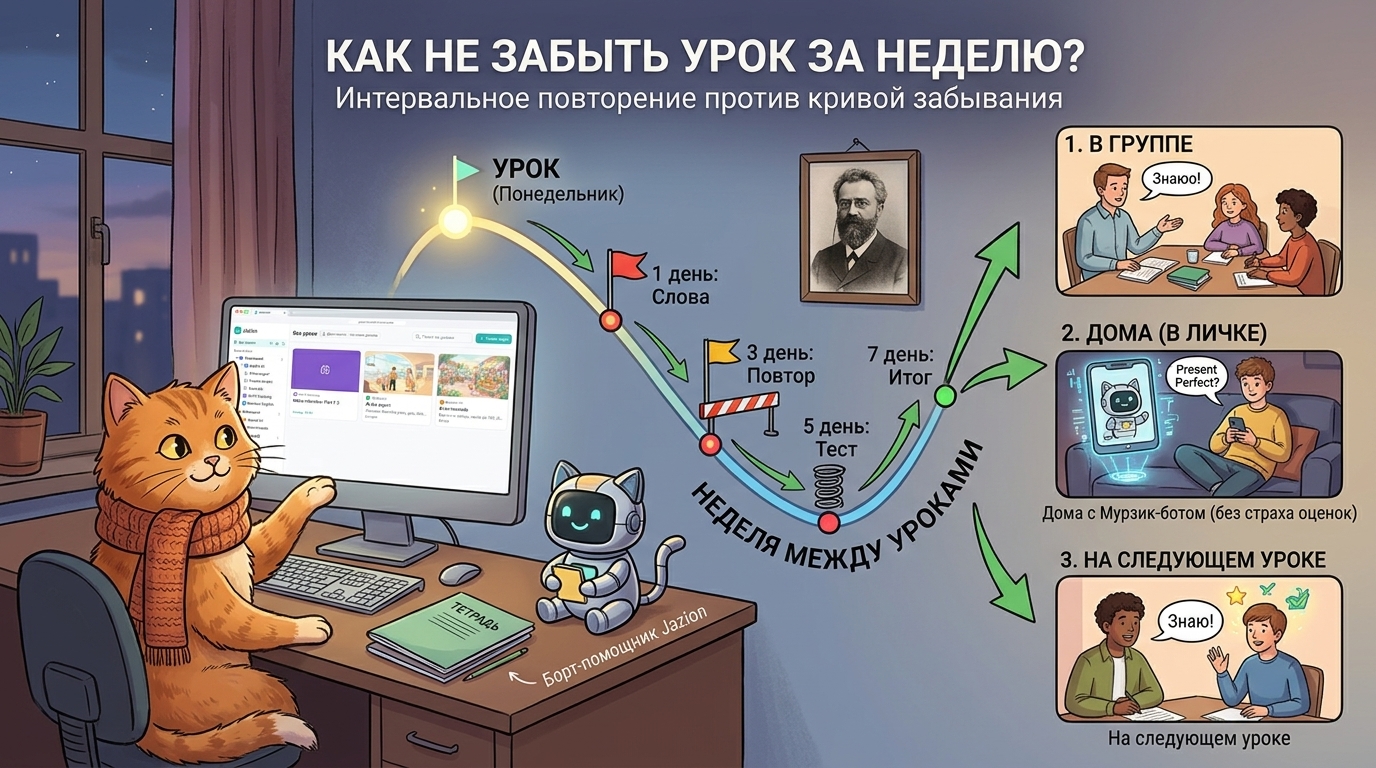
TL;DR: A lesson lasts an hour, the gap until the next one is a week, and without review little of the new material survives it; in a group students also ask and recall out loud less often. Two proven things help: recalling instead of rereading, and reviewing with gaps. Inside: seven techniques for your next class that need no tools, and an honest account of which part of the work between lessons you can hand over to a bot while the teacher stays in charge.
Most new material is forgotten within the first day, and a week between lessons leaves little of it. In a group this is made worse by silence and the fear of making a mistake in front of others. Below: what psychologists know about it, seven techniques that need no apps, and which part of the work we handed over to a bot and why.
Editor's note: this article was ready back in winter, but its publication was put off for various reasons. Recently it won the vote in our Telegram channel as the topic readers most wanted, so: you asked, we answer. The Jazion bot has changed since then, so we have updated the description of how it works.
On Thursday you went through the Present Perfect with your group. You gave examples, did the exercises, everyone nodded. A week later you ask how I have lived here differs from I lived here, and the room goes quiet. Someone flips through a notebook, someone looks out of the window, the bravest says something unsure about the past.
This happens less with a one-to-one student. They ask right away, and you can see on their face where they got lost. In a group these signals get lost.
We are programmers and have no degree in education (we are close to the education field and have teaching experience, but not in teaching foreign languages). But while building Jazion, an assistant for tutors in Telegram, we had to really dig into how memory works. It turned out that forgetting is described quite precisely, that the group format has properties that make it worse, and that there are simple techniques against most of these effects.
A curve that is 140 years old
In 1885 the German psychologist Hermann Ebbinghaus memorised lists of nonsense syllables and checked what was left of them. He measured it cleverly. Ebbinghaus learned the list again and looked at how much time he saved. If relearning went a third faster, he counted a third as retained in memory.
After 20 minutes he had lost about 40% of what he learned, after an hour more than half, after a day roughly two thirds. After six days a quarter was left. In 2015 the experiment was repeated and gave a curve of the same shape (Murre & Dros, 2015). Meaningful material holds better than syllables, but without review new material still goes fast, and fastest in the first day.
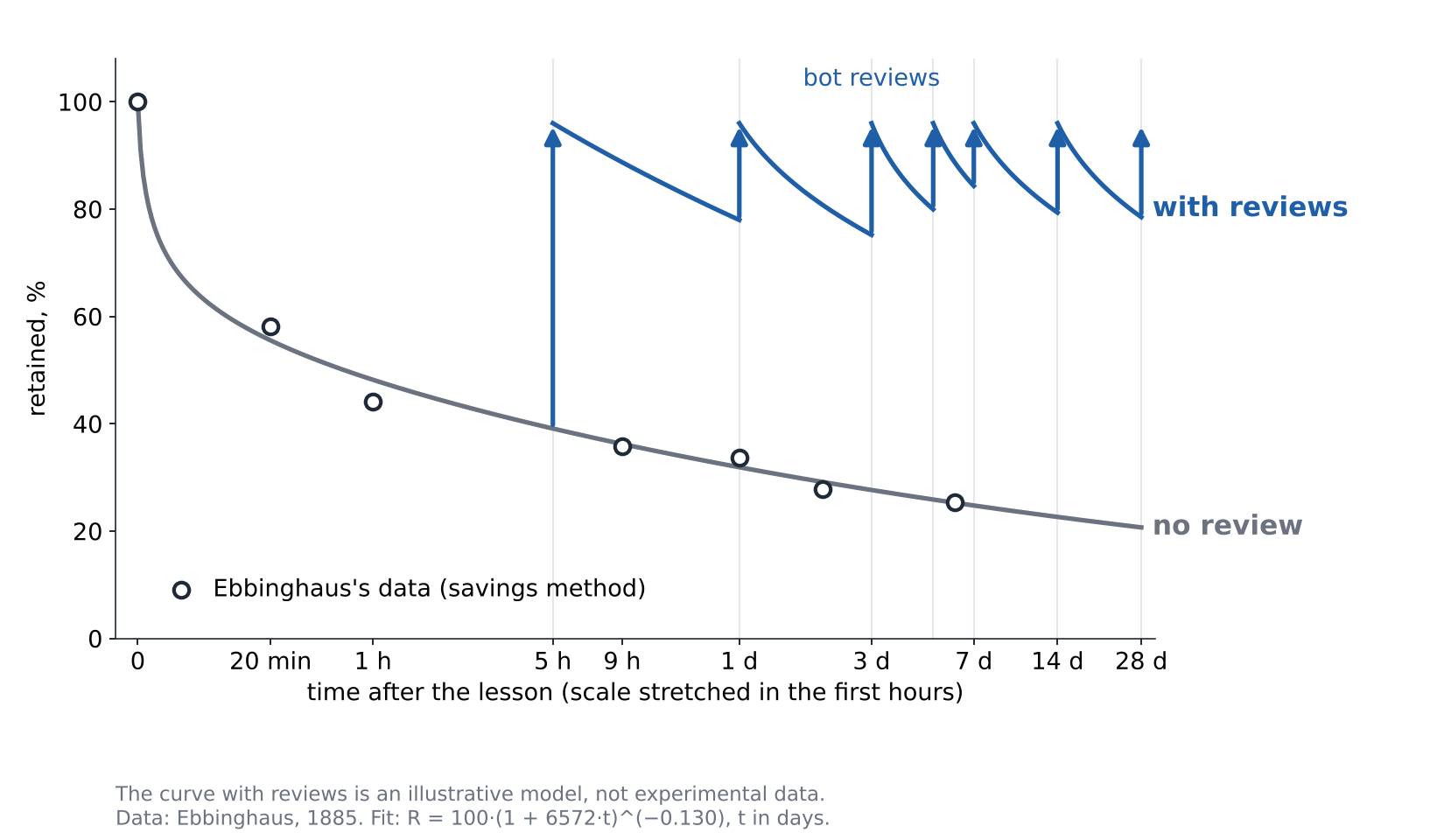 Fig. 1. The dots are Ebbinghaus's data (1885). The blue line is an illustration and was not measured: it shows how each review brings material back and the next drop gets slower. The review days match the Jazion bot's schedule.
If a group meets once a week and nobody touches the material between lessons, little of it is left by the next class.
For a tutor this is a question not only of method but of money. At our meetup for language teachers in Novi Sad one of the talks put it plainly: students come and say "I don't see any results", and it is not always clear what to answer. We hear the same complaint whenever we collect tutors' pain points: a student forgets what was covered, stops feeling progress and takes a break from lessons. A student who does not remember the last lesson does not see results either, so review between lessons keeps not only the material but the student too.
What gets in the way of recall in a group?
We did not find studies of forgetting in mini-groups specifically. But each mechanism below has been studied on its own, and they all pull in the same direction.
The bystander effect. The more people around, the less each one feels that they are the one who should act. "I'm probably the only one who didn't get it, the others are nodding."
At Arizona State University, 417 students in large science classes were surveyed (Nadile et al., 2021). More than half never asked or answered a question in front of the class during the semester, although almost all of them find other people's questions useful. The main obstacle is fear of negative evaluation. These are classes of hundreds of people; in a group of six the effect is probably weaker, but it works the same way.
Fear of evaluation. Back in 1968 the psychologist Nickolas Cottrell suggested that what holds a person back in front of others is mainly the expectation of being judged (Cottrell, 1968). In the classic study of language anxiety, 49% of students admitted they start to panic when they have to speak without preparation, and 47% did not feel confident when speaking in class (Horwitz, Horwitz & Cope, 1986). And spontaneous speech is exactly what students come to a conversation group for.
Social loafing. Participants in an experiment were asked to clap and shout as loudly as they could. In a group each person was quieter than alone (Latané, Williams & Harkins, 1979). In a lesson this turns into "someone will answer".
There is a related effect. A group that recalls material together remembers less than the same people recalling separately, if you add up their answers (Weldon & Bellinger, 1997). So first everyone recalls on their own, and the discussion comes after.
One pace for all. One student has already got it and is bored, another is still confused, and the lesson moves on. Let's count: 60 minutes, eight students, the teacher speaks half the time. That leaves each student three or four minutes of their own speech.
What helps you remember a lesson: recall and gaps
Recalling beats rereading. Roediger and Karpicke gave students a study text (Roediger & Karpicke, 2006). Some reread it four times, others read it once and three times wrote down from memory everything they could recall. After five minutes the rereaders were ahead, 83% versus 71%. After a week they had 40% left, the recallers 61%. And the rereaders were more confident about their memory.
In a follow-up study by the same authors, words a student had already recalled once and kept meeting in tests were remembered more than twice as well a week later as words dropped from the tests (Karpicke & Roediger, 2007). What a student once got right is too early to cross off the quizzes.
In a review of 50 experiments in real schools and classrooms, the benefit of recall was medium or large in 57% of cases (Agarwal, Nunes & Blunt, 2021). In a large review of study techniques, self-testing and distributed practice got the highest utility rating, while rereading and highlighting got a low one (Dunlosky et al., 2013).
Review with gaps. Review spread out over time works better than review in one go; a meta-analysis of 317 experiments confirmed it (Cepeda et al., 2006). When exactly to review was shown by an experiment with more than 1,350 participants (Cepeda et al., 2008). If the test is in a week, review after a day and a half to three days. If it is in a month, after about a week. If the exam is in a year, after three to five weeks. Review at the right moment gave 64% more correct answers than review right after learning, and reviewing a bit late turned out to be less harmful than reviewing too early.
For languages there is a separate meta-analysis of 48 experiments (Kim & Webb, 2022). On delayed tests, the average student who reviewed with gaps outperformed about 87% of those who learned the same material in one sitting. Equal gaps worked no worse than growing ones.
What to do in your very next lesson
A sheet of paper or the group's shared chat is enough for these techniques.
- Warm-up on the last lesson. Give the first five minutes of class to three or four questions on the previous topic. Everyone answers in writing and without the notebook, and you check together afterwards. For example: "Write three verbs we covered last time and a sentence with one of them." The week between lessons gives exactly the gap you need.
- Exit ticket. Three minutes before the end of the lesson, each student writes on a slip of paper or in a private message one thing they remembered and one question. The student recalls the material once more, you see who got confused, and nobody has to admit it in front of everyone.
- Anonymous questions. A box for notes, an anonymous form or the agreement "write to me privately". Since the main reason for silence is fear of evaluation, remove the evaluation. At the start of the next lesson go through these questions without naming the authors.
- Think, pair, share. After asking a question, give a minute to think silently and write down an answer. Then pairs compare, and only after that someone answers to the group. Everyone gets to recall on their own, and saying something to one partner is easier than to the whole class.
- Mini-tests without marks. Short five-minute self-checks that count for nothing. The lower the stakes, the less anxiety. Include things students already know: recalling again strengthens memory even after a correct answer.
- A simple review schedule. Estimate when the material will be needed and count back using the rule from Cepeda's study. If the test is in a month, review the topic in about a week. For a group with one lesson a week three touches are enough: five minutes of self-testing at home the next day, the warm-up at the next lesson and a short review in three or four weeks.
- Equal gaps work too. Equal gaps are as good as growing ones, so the rule "every week we recall the previous topics" already gives results. If you can, stretch the gaps out. It pays off on delayed tests.
Almost all of these techniques rely on everyone answering in writing. Then nobody can hide behind other people's answers, and nobody has to take a risk in front of the group.
Teacher and AI: what the data show
The hardest part begins between lessons. Sending each of eight students the right question on the right day by hand, and remembering who got what wrong, is almost impossible. Software can handle it, but with one caveat.
In a meta-analysis of 19 studies of generative AI in education, the result depended heavily on the teacher's involvement (Gu & Yan, 2025). When a teacher accompanied the work with AI, the effect was large: the average student outperformed about 92% of students in the control group. Without a teacher the effect was close to zero, about as good as a coin toss. Comparing the two effect sizes gives the figure from our first post: the effect with a teacher is 18 times stronger. There are still few studies, so treat this as a guide rather than a law.
Other studies point the same way. In a field experiment with almost a thousand high-school students in Turkey, an ordinary GPT-4 chatbot helped solve problems while it was at hand. In the exam without it, these students did 17% worse than those who had no access at all. A version of the bot with guardrails, which gave hints and did not hand out ready answers, largely removed this harm (Bastani et al., 2025).
The OECD comes to a similar conclusion in its 2026 review. Without a pedagogical framework, AI helps to complete a task but does little to help learn something (OECD, 2026). Analysts at Brookings consider a hybrid, where teacher and AI work together, the best option (Burns, 2026).
Well-designed AI does help, though. In a randomised experiment in a physics course at Harvard, students with an AI tutor built on pedagogical principles learned more than twice as much in less time as in an active-learning class session (Kestin et al., 2025).
In the Tutor CoPilot experiment, AI gave hints to tutors during the session and wrote nothing to students. The share of students who mastered the topic rose by 4 percentage points, and by 9 for lower-rated tutors. It cost about 20 dollars a year per tutor (Wang et al., 2024).
From these data we derived a rule for ourselves: the bot continues the teacher's lesson and does not try to replace it.
[!spotlight] How it works in Jazion
The main bot features each answer one of the mechanisms above.
The first day → a summary the same evening. The teacher forwards the lesson recording to the bot in Telegram. The bot transcribes it, picks out the topics and builds a summary, which goes to the group chat as soon as it is ready, usually the same evening. This is the first touch with the material in the hours when the forgetting curve is steepest.
Review with gaps → a schedule. From the lesson material the bot makes short tasks: new words, word review, grammar quizzes, sentences with new words. The first task comes a few hours after the lesson, then on days 1, 3, 5, 7, 14 and 28. After that the lesson goes into cumulative reviews together with earlier ones. With two or three lessons a week there are fewer reviews per lesson, because the lessons themselves already create repetition. By default the bot writes at most once every two days and no more than five times a week, and the teacher can change the frequency.
Fear of evaluation and "someone will answer" → tasks in private messages. The teacher can switch on delivery of tasks to private messages. Then each student gets their own quiz, answers alone, makes mistakes without witnesses and sees a short explanation right after a wrong answer.
Too shy to ask → a question about the lesson. A student can ask the bot a question in plain words in the group chat by addressing it by name. The bot searches the transcripts and summaries of this course's lessons and answers based on the teacher's own explanation. If there is nothing on the topic in the lessons, the bot gives a general answer.
Mascots. A course can have a character the bot speaks for: a strict professor, a friendly owl or an ironic robot. We know of no studies proving that such a character increases engagement in exactly this setup. For now it is our hypothesis, and we are testing it.
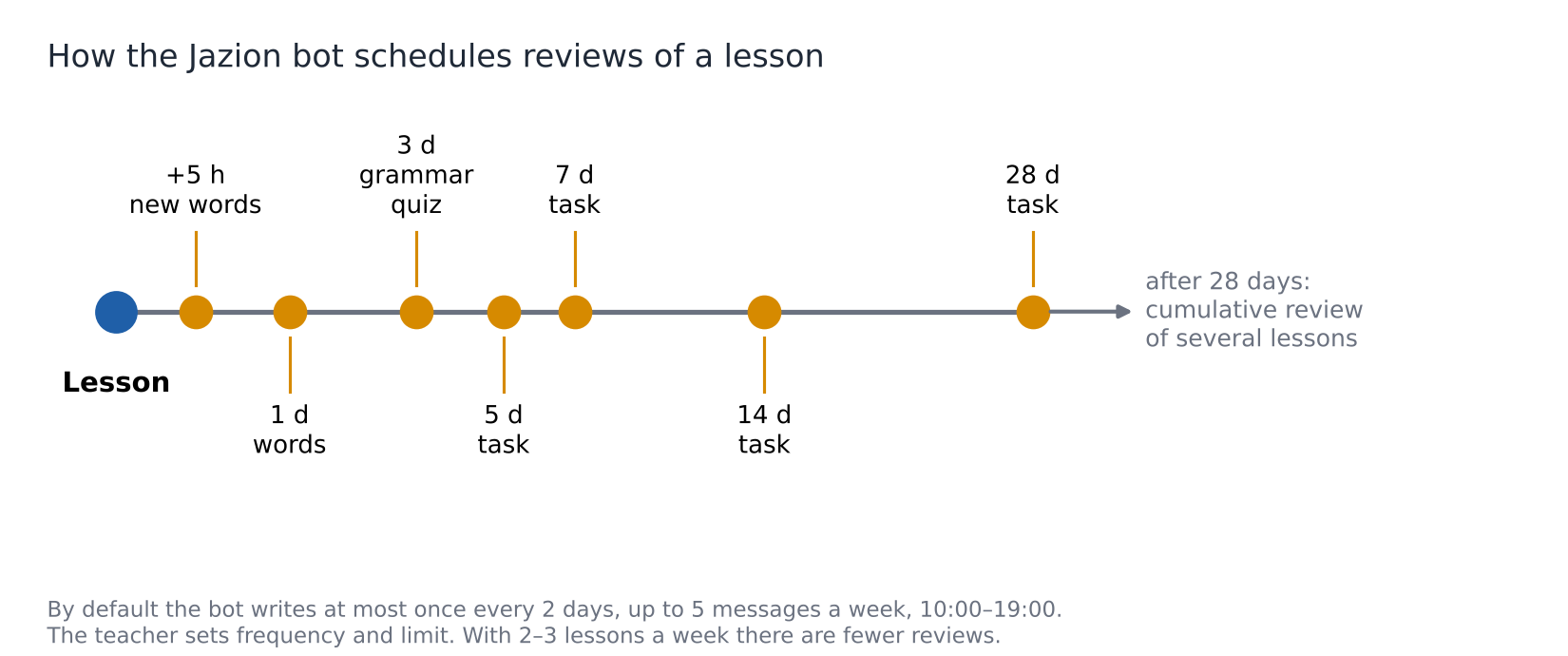 Fig. 2. How the bot schedules reviews of one lesson. Equal or growing gaps both work (Kim & Webb, 2022); what matters is that the reviews happen at all.
Masha's week
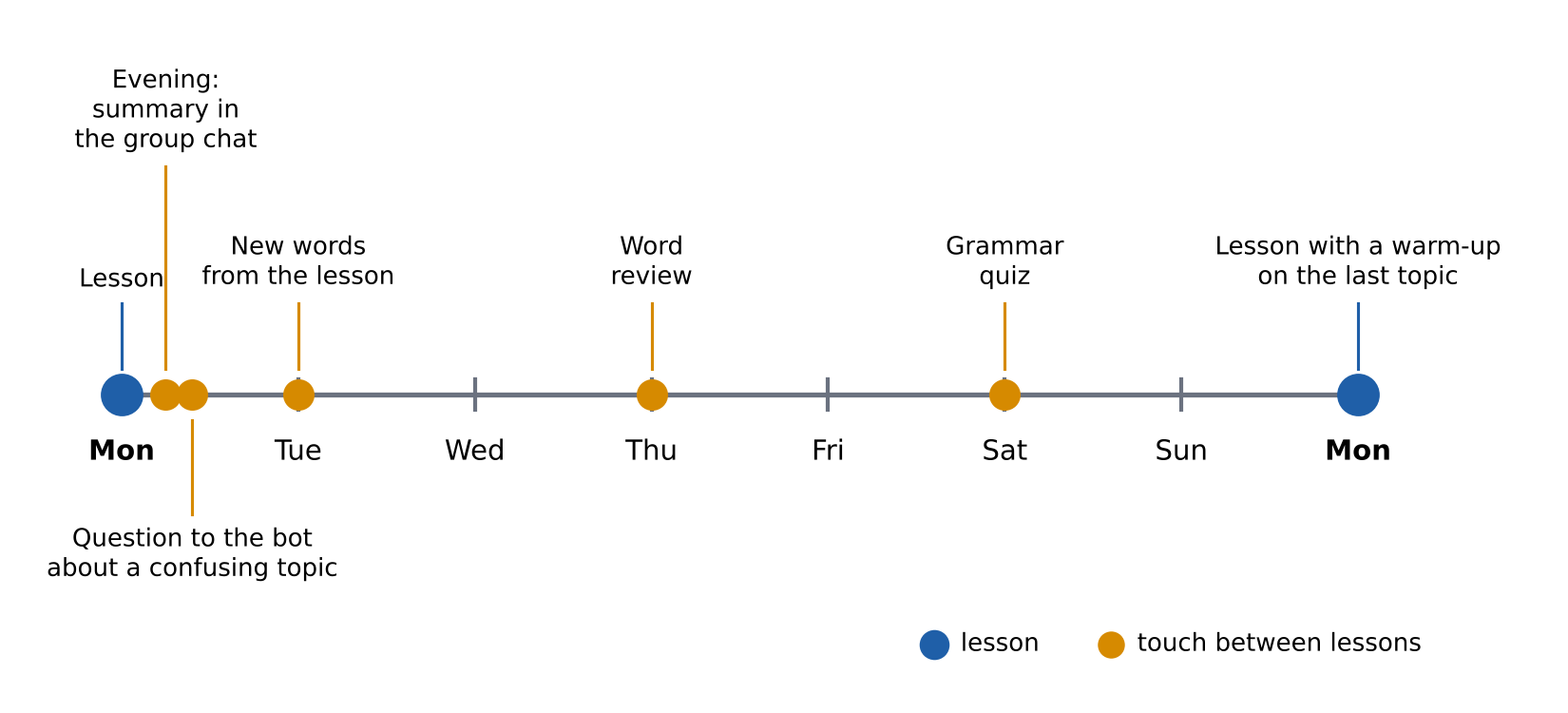 Fig. 3. Masha's week with the default settings: the bot writes at most once every two days, between 10:00 and 19:00.
Monday, 18:00. An English lesson in a group of five. The teacher records audio on the phone and forwards it to the bot after class. In the evening a summary arrives in the group chat.
Monday, evening. Masha did not get the difference between the Present Perfect and the Past Simple, but did not ask again in class. In the evening she asks the bot in the group chat: there is no need to wait for the next lesson, and the bot answers based on the part of the lesson where the teacher explained this topic.
Tuesday. New words from the lesson arrive in the morning: a short task on what was covered the day before.
Thursday. Word review. Masha answers two questions correctly and gets one wrong.
Saturday. A grammar quiz on the lesson: the same Present Perfect. The teacher has switched on tasks in private messages, so Masha answers alone and is not afraid to make a mistake. If she gets it wrong, she sees a short explanation right away.
Next Monday. In the evening the teacher starts the lesson with a warm-up on the previous class and builds the new material on the old.
Two and four weeks later. The topic comes back once more, and then appears in the cumulative reviews together with other lessons.
Honest about the limitations
- The summary is written by a language model. It can miss a nuance or not get a joke. For now it goes to the chat without the teacher's prior check, so it is worth repeating the key points at the next lesson.
- One schedule for the whole group. The bot does not yet adjust gaps to the mistakes of a specific student: a topic Masha got wrong comes back on the common schedule, not earlier.
- Gaps are a guide. Cepeda's data come from adults learning facts. For grammar and speaking skills the best gaps may be different.
- Mini-groups are barely studied. The data on silence and anxiety come from university students. Carrying them over to a group of five remains our assumption.
- The bot does not explain instead of the teacher. If a topic is misunderstood, review will reinforce the mistake.
In short
- Material is forgotten fastest in the first day. If nobody touches it between lessons, little is left by the next class.
- In a group this is made worse by silence, fear of evaluation and the hope that someone else will answer. These effects are predictable and can be built into how the lesson is set up.
- Recall practice instead of rereading and review with gaps work best. Both can be built into lessons this very week.
- Software is useful where you need to keep a review schedule for every student, and it works well when the teacher is in charge.
FAQ
How often should a group review the material? Count back from when the material will be needed: for a test in a week, review after a day and a half to three days; in a month, after about a week (Cepeda et al., 2008). For a group that meets once a week, three touches are enough: a self-check the next day, a warm-up at the next lesson and a short review in three or four weeks.
Why don't students ask questions in a group? The main reason is fear of negative evaluation: more than half of the students in large classes never asked a question during a semester (Nadile et al., 2021). Exit tickets, anonymous questions and "think, pair, share" remove that evaluation.
What works better: rereading the summary or testing yourself? Testing yourself. A week later students who recalled the text kept 61% of it, those who reread it 40% (Roediger & Karpicke, 2006).
Can AI replace the teacher between lessons? The data say no. With a teacher the effect of AI was large, without one close to zero (Gu & Yan, 2025). AI is useful for keeping a review schedule; diagnosis and explanation stay with the teacher.
Want your lesson to keep going between classes? Connect your group to Jazion: the summary and the first tasks arrive after your next lesson, and you decide what to review and how often.
Editor: Sergey Arkhipov
Sources
- Ebbinghaus, H. (1885). Über das Gedächtnis: Untersuchungen zur experimentellen Psychologie. Leipzig: Duncker & Humblot.
- Murre, J. M. J., & Dros, J. (2015). Replication and analysis of Ebbinghaus' forgetting curve. PLOS ONE, 10(7), e0120644. https://doi.org/10.1371/journal.pone.0120644
- Nadile, E. M., Alfonso, E., Barreiros, B. M., Bevan-Thomas, W. D., Brownell, S. E., Chin, M. R., et al. (2021). Call on me! Undergraduates' perceptions of voluntarily asking and answering questions in front of large-enrollment science classes. PLOS ONE, 16(1), e0243731. https://doi.org/10.1371/journal.pone.0243731
- Cottrell, N. B. (1968). Performance in the presence of other human beings: Mere presence, audience, and affiliation effects. In E. C. Simmel, R. A. Hoppe, & G. A. Milton (Eds.), Social facilitation and imitative behavior (pp. 91–110). Boston: Allyn & Bacon.
- Horwitz, E. K., Horwitz, M. B., & Cope, J. (1986). Foreign language classroom anxiety. The Modern Language Journal, 70(2), 125–132. https://doi.org/10.1111/j.1540-4781.1986.tb05256.x
- Latané, B., Williams, K., & Harkins, S. (1979). Many hands make light the work: The causes and consequences of social loafing. Journal of Personality and Social Psychology, 37(6), 822–832. https://doi.org/10.1037/0022-3514.37.6.822
- Weldon, M. S., & Bellinger, K. D. (1997). Collective memory: Collaborative and individual processes in remembering. Journal of Experimental Psychology: Learning, Memory, and Cognition, 23(5), 1160–1175. https://doi.org/10.1037/0278-7393.23.5.1160
- Roediger, H. L., & Karpicke, J. D. (2006). Test-enhanced learning: Taking memory tests improves long-term retention. Psychological Science, 17(3), 249–255. https://doi.org/10.1111/j.1467-9280.2006.01693.x
- Karpicke, J. D., & Roediger, H. L. (2007). Repeated retrieval during learning is the key to long-term retention. Journal of Memory and Language, 57(2), 151–162. https://doi.org/10.1016/j.jml.2006.09.004
- Agarwal, P. K., Nunes, L. D., & Blunt, J. R. (2021). Retrieval practice consistently benefits student learning: A systematic review of applied research in schools and classrooms. Educational Psychology Review, 33(4), 1409–1453. https://doi.org/10.1007/s10648-021-09595-9
- Cepeda, N. J., Pashler, H., Vul, E., Wixted, J. T., & Rohrer, D. (2006). Distributed practice in verbal recall tasks: A review and quantitative synthesis. Psychological Bulletin, 132(3), 354–380. https://doi.org/10.1037/0033-2909.132.3.354
- Cepeda, N. J., Vul, E., Rohrer, D., Wixted, J. T., & Pashler, H. (2008). Spacing effects in learning: A temporal ridgeline of optimal retention. Psychological Science, 19(11), 1095–1102. https://doi.org/10.1111/j.1467-9280.2008.02209.x
- Kim, S. K., & Webb, S. (2022). The effects of spaced practice on second language learning: A meta-analysis. Language Learning, 72(1), 269–319. https://doi.org/10.1111/lang.12479
- Gu, J., & Yan, Z. (2025). Effects of GenAI interventions on student academic performance: A meta-analysis. Journal of Educational Computing Research, 63(6), 1460–1492. https://doi.org/10.1177/07356331251349620
- Bastani, H., Bastani, O., Sungu, A., Ge, H., Kabakcı, Ö., & Mariman, R. (2025). Generative AI without guardrails can harm learning: Evidence from high school mathematics. Proceedings of the National Academy of Sciences, 122(26), e2422633122. https://doi.org/10.1073/pnas.2422633122
- OECD (2026). OECD Digital Education Outlook 2026: Exploring Effective Uses of Generative AI in Education. Paris: OECD Publishing. https://doi.org/10.1787/062a7394-en
- Burns, M. (2026, January 27). What the research shows about generative AI in tutoring. Brookings Institution. https://www.brookings.edu/articles/what-the-research-shows-about-generative-ai-in-tutoring/
- Kestin, G., Miller, K., Klales, A., Milbourne, T., & Ponti, G. (2025). AI tutoring outperforms in-class active learning: An RCT introducing a novel research-based design in an authentic educational setting. Scientific Reports, 15, 17458. https://doi.org/10.1038/s41598-025-97652-6
- Wang, R. E., Ribeiro, A. T., Robinson, C. D., Loeb, S., & Demszky, D. (2024). Tutor CoPilot: A human-AI approach for scaling real-time expertise. arXiv preprint arXiv:2410.03017. https://arxiv.org/abs/2410.03017
- Dunlosky, J., Rawson, K. A., Marsh, E. J., Nathan, M. J., & Willingham, D. T. (2013). Improving students' learning with effective learning techniques. Psychological Science in the Public Interest, 14(1), 4–58. https://doi.org/10.1177/1529100612453266
Кривая забывания в группе: почему ученики забывают урок за неделю и что с этим делать репетитору
Кривая забывания и групповые уроки: что известно о памяти, семь приёмов для следующего занятия и какую часть работы отдать боту.
TL;DR: Урок длится час, до следующего проходит неделя, и без повторения от нового материала к нему остаётся немного; в группе ученики к тому же реже переспрашивают и вспоминают вслух. Помогают две доказанные вещи: вспоминать, а не перечитывать, и повторять с промежутками. Внутри семь приёмов для следующего урока без всяких сервисов и честно о том, какую часть работы между уроками можно отдать боту, оставив главное за преподавателем.
Больше всего нового материала забывается в первые сутки, и за неделю между уроками от него остаётся немного. В группе к этому добавляются молчание и страх ошибиться при всех. Мы разобрались, что об этом известно психологам. В статье семь приёмов, для которых не нужны никакие сервисы, и рассказ о том, какую часть работы мы отдали боту и почему.
От редакции: статья была готова ещё зимой, но публикацию по разным причинам отложили. Недавно в голосовании нашего Telegram-канала эта тема оказалась самой интересной для читателей, так что спрашивали — отвечаем. За это время бот Jazion изменился, поэтому описание его работы мы обновили.
В четверг вы разбирали с группой Present Perfect. Привели примеры, сделали упражнения, все кивали. Через неделю спрашиваете, чем I have lived here отличается от I lived here, и в классе становится тихо. Кто-то листает тетрадь, кто-то смотрит в окно, самый смелый говорит что-то неуверенное про прошлое.
С индивидуальным учеником такое случается реже. Он переспрашивает сразу, и по его лицу видно, где он потерялся. В группе эти сигналы тонут.
Мы программисты, педагогического образования у нас нет (хотя к сфере образования мы близки и опыт преподавания у нас есть, но не иностранного языка). Но пока мы делали Jazion, помощника для репетиторов в Telegram, пришлось всерьёз разобраться, как работает память. Оказалось, что забывание довольно точно описано, у группового формата есть свойства, которые его усиливают, и против большинства этих эффектов есть простые приёмы.
Кривая, которой 140 лет
В 1885 году немецкий психолог Герман Эббингауз заучивал списки бессмысленных слогов и проверял, что от них осталось. Мерил он хитро. Эббингауз выучивал список заново и смотрел, сколько времени удалось сэкономить. Если повторное заучивание шло на треть быстрее, он считал, что в памяти сохранилась треть.
Через 20 минут он терял около 40% выученного, через час больше половины, через сутки примерно две трети. Через шесть дней оставалась четверть. В 2015 году эксперимент повторили и получили кривую той же формы (Murre & Dros, 2015). Осмысленный материал держится лучше слогов, но без повторения новое всё равно быстро уходит, и сильнее всего в первые сутки.
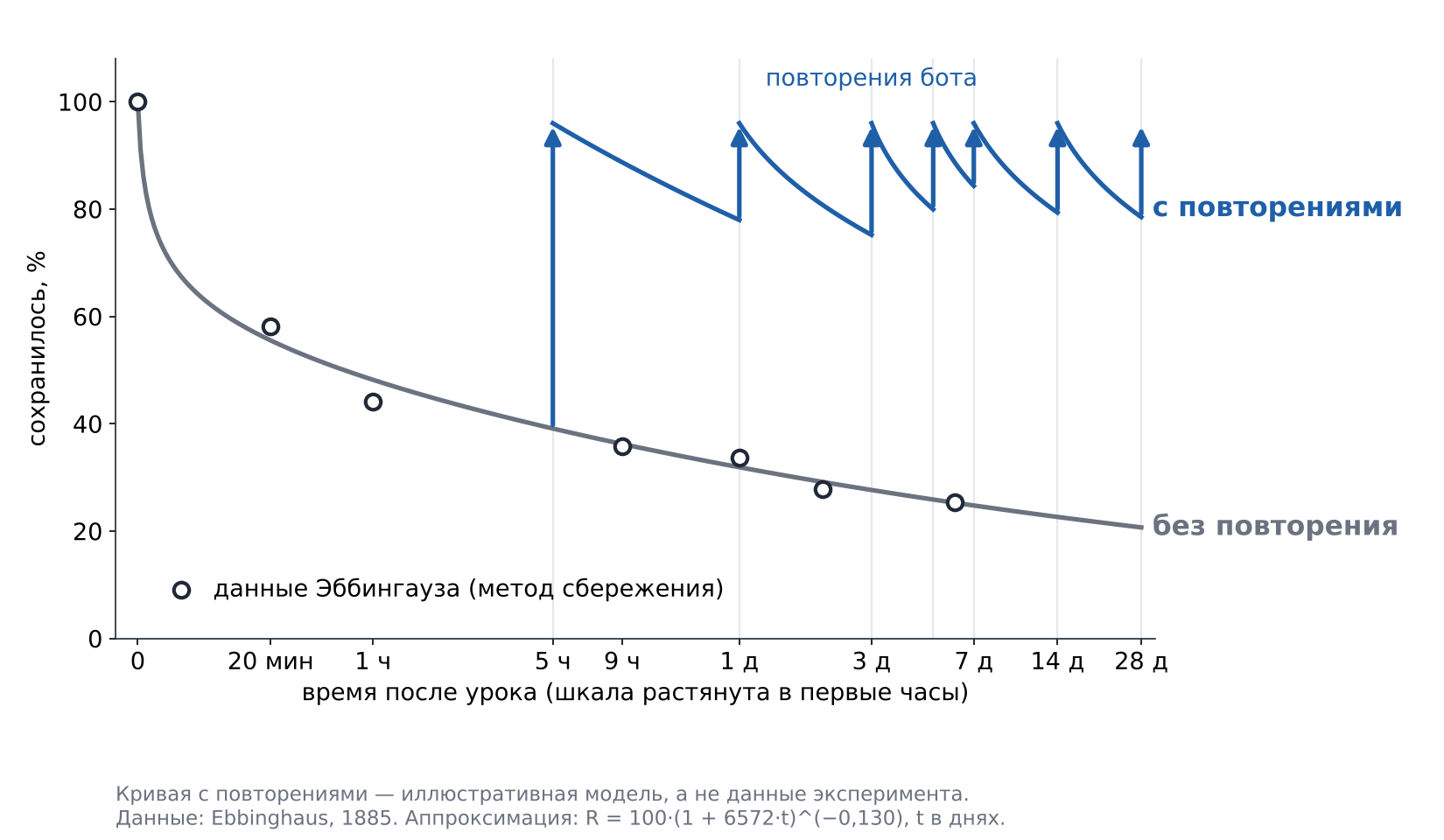 Рис. 1. Точки показывают данные Эббингауза (1885). Синяя линия нарисована для наглядности и в эксперименте не измерялась. Она показывает, как каждое повторение возвращает материал в память и следующий спад идёт медленнее. Дни повторений совпадают с расписанием бота Jazion.
Если группа занимается раз в неделю и между уроками материал никто не трогает, к следующему занятию от него остаётся немного.
Для репетитора это вопрос не только методики, но и денег. На нашей встрече преподавателей языков в Нови-Саде в одном из докладов прозвучало прямо: ученики приходят со словами «я не вижу результат», и что им ответить, не всегда понятно. Ту же жалобу мы слышим каждый раз, когда собираем боли репетиторов: ученик забывает пройденное, перестаёт чувствовать прогресс и берёт паузу в занятиях. Ученик, который не помнит прошлый урок, не видит и результата, поэтому повторение между уроками удерживает не только материал, но и самого ученика.
Что мешает группе вспоминать?
Исследований забывания именно в мини-группах мы не нашли. Но каждый механизм ниже изучен отдельно, и все они действуют в одну сторону.
Эффект свидетеля. Чем больше людей вокруг, тем меньше каждый чувствует, что действовать должен именно он. «Наверное, только я не понял, остальные же кивают».
В Университете штата Аризона опросили 417 студентов больших потоков по естественным наукам (Nadile et al., 2021). Больше половины за семестр ни разу не задавали вопросов и не отвечали на вопросы преподавателя перед аудиторией, хотя почти все считают чужие вопросы полезными. Мешает в первую очередь страх негативной оценки. Речь о потоках в сотни человек, и в группе из шести эффект, вероятно, слабее, но устроен так же.
Страх оценки. Психолог Николас Коттрелл ещё в 1968 году предположил, что при посторонних человека сковывает главным образом ожидание оценки (Cottrell, 1968). В классической работе о языковой тревожности 49% студентов признались, что начинают паниковать, когда приходится говорить без подготовки, и 47% не чувствовали уверенности, когда говорили на занятии (Horwitz, Horwitz & Cope, 1986). А ведь ради спонтанной речи ученики и приходят в разговорную группу.
Социальная лень. Участников эксперимента просили хлопать и кричать как можно громче. В группе каждый шумел тише, чем поодиночке (Latané, Williams & Harkins, 1979). На уроке это превращается в «кто-нибудь ответит».
Есть и похожий эффект. Группа, которая вспоминает материал вместе, вспоминает меньше, чем те же люди по отдельности, если сложить их ответы (Weldon & Bellinger, 1997). Поэтому сначала каждый вспоминает сам, обсуждать лучше потом.
Единый темп. Один уже понял и скучает, другой ещё путается, и урок тем временем идёт дальше. Посчитаем: 60 минут, восемь учеников, половину времени говорит преподаватель. На каждого остаётся три-четыре минуты собственной речи.
Что помогает запомнить урок: вспоминать и делать паузы
Вспоминать полезнее, чем перечитывать. Рёдигер и Карпике дали студентам учебный текст (Roediger & Karpicke, 2006). Одни перечитывали его четыре раза, другие прочитали один раз и трижды записывали по памяти всё, что смогли вспомнить. Через пять минут перечитывавшие выигрывали, 83% против 71%. Через неделю у них осталось 40%, у вспоминавших 61%. При этом перечитывавшие были увереннее в своей памяти.
В следующей работе тех же авторов слова, которые студент уже один раз вспомнил и продолжал встречать в проверках, через неделю помнили более чем вдвое лучше, чем слова, убранные из проверок (Karpicke & Roediger, 2007). То, что ученик однажды назвал правильно, рано вычёркивать из опросов.
В обзоре 50 экспериментов в настоящих школах и классах польза от вспоминания в 57% случаев оказалась средней или большой (Agarwal, Nunes & Blunt, 2021). В большом обзоре учебных техник самопроверка и распределённая практика получили высшую оценку полезности, перечитывание и выделение маркером получили низкую (Dunlosky et al., 2013).
Повторять с промежутками. Растянутое во времени повторение работает лучше повторения одним заходом, это подтвердил метаанализ 317 экспериментов (Cepeda et al., 2006). Когда именно повторять, показал эксперимент с более чем 1350 участниками (Cepeda et al., 2008). Если контрольная через неделю, повторите через полтора-три дня. Если через месяц, примерно через неделю. Если экзамен через год, через три-пять недель. Повторение в удачный момент дало на 64% больше правильных ответов, чем повторение сразу после изучения, а повторить чуть позже оказалось не так вредно, как слишком рано.
Для языков есть отдельный метаанализ 48 экспериментов (Kim & Webb, 2022). На отложенных тестах средний ученик, который повторял с промежутками, обгонял около 87% тех, кто учил тот же материал за один присест. Равные промежутки при этом работали не хуже растущих.
Что сделать уже на следующем уроке
Для этих приёмов достаточно листка бумаги или общего чата группы.
- Разминка по прошлому уроку. Первые пять минут занятия отдайте трём-четырём вопросам по прошлой теме. Каждый отвечает письменно и без тетради, сверяетесь вы уже потом. Например: «Напишите три глагола, которые мы разбирали в прошлый раз, и предложение с одним из них». Неделя между уроками как раз даёт нужный промежуток.
- Билет на выход. За три минуты до конца урока каждый пишет на листке или в личном сообщении одну вещь, которую запомнил, и один вопрос. Ученик ещё раз вспоминает материал, вы видите, кто запутался, и признаваться в этом при всех никому не нужно.
- Анонимные вопросы. Коробка для записок, анонимная форма или договорённость «пишите мне в личку». Раз главная причина молчания в страхе оценки, уберите оценку. В начале следующего урока разберите эти вопросы, не называя авторов.
- Подумай, обсуди с соседом, скажи всем. Задав вопрос, дайте минуту подумать молча и записать ответ. Потом пары сверяются, и только после этого кто-то отвечает группе. Каждый успевает вспомнить сам, а сказать что-то одному партнёру проще, чем всему классу.
- Мини-тесты без отметок. Короткие самопроверки минут на пять, которые ни на что не влияют. Чем меньше ставка, тем меньше тревоги. Включайте в них и то, что ученики уже знают, ведь повторное вспоминание укрепляет память даже после правильного ответа.
- Простое расписание повторений. Прикиньте, когда материал понадобится, и отсчитайте назад по правилу из исследования Сепеды. Если контрольная через месяц, повторите тему примерно через неделю. Группе с уроком раз в неделю хватит трёх касаний: пять минут самопроверки дома на следующий день, разминка на следующем уроке и короткий повтор через три-четыре недели.
- Ровные интервалы тоже работают. Равные промежутки не уступают растущим, поэтому правило «каждую неделю вспоминаем прошлые темы» уже даёт результат. Если есть возможность, растягивайте промежутки. На отложенных тестах это окупается.
Почти все эти приёмы держатся на том, что письменно отвечают все. За чужие ответы тогда не спрячешься, и рисковать перед группой тоже не приходится.
Учитель и ИИ: что показывают данные
Самое трудное начинается между уроками. Вручную отправить каждому из восьми учеников нужный вопрос в нужный день и помнить, кто в чём ошибся, почти нереально. С этим справится программа, но с одной оговоркой.
В метаанализе 19 исследований генеративного ИИ в обучении результат сильно зависел от участия учителя (Gu & Yan, 2025). Когда преподаватель сопровождал работу с ИИ, эффект был большим. Средний ученик обгонял примерно 92% учеников из контрольной группы. Без преподавателя эффект был около нуля, примерно как при подбрасывании монетки. Если сравнить два размера эффекта, получится цифра из нашего первого поста: с учителем эффект в 18 раз сильнее. Исследований пока мало, поэтому это скорее ориентир.
Другие работы указывают в ту же сторону. В полевом эксперименте почти с тысячей старшеклассников в Турции обычный чат-бот на GPT-4 помогал решать задачи, пока был под рукой. На экзамене без него эти школьники справились на 17% хуже тех, у кого доступа не было вовсе. Версия бота с ограничениями, которая подсказывала и не выдавала готовых ответов, этот вред в основном снимала (Bastani et al., 2025).
ОЭСР в обзоре 2026 года приходит к похожему выводу. Без педагогической рамки ИИ помогает выполнить задание, но мало помогает чему-то научиться (OECD, 2026). Аналитики Brookings считают лучшим гибридный вариант, где учитель и ИИ работают вместе (Burns, 2026).
Хорошо спроектированный ИИ при этом действительно помогает. В рандомизированном эксперименте на курсе физики в Гарварде студенты с ИИ-тьютором, построенным по принципам педагогики, усвоили больше чем вдвое за меньшее время, чем на активном занятии в аудитории (Kestin et al., 2025).
В эксперименте Tutor CoPilot ИИ подсказывал тьюторам во время занятия, ученикам он ничего не писал. Доля учеников, освоивших тему, выросла на 4 процентных пункта, у тьюторов с более низким рейтингом на 9. Обошлось это примерно в 20 долларов в год на одного тьютора (Wang et al., 2024).
Из этих данных мы вывели для себя правило. Бот продолжает урок преподавателя и не пытается его заменить.
[!spotlight] Как это работает в Jazion
Основные функции бота отвечают каждая на один из механизмов выше.
Первые сутки → конспект в тот же вечер. Преподаватель пересылает запись урока боту в Telegram. Бот расшифровывает её, выделяет темы и собирает конспект, который уходит в чат группы, как только готов, обычно в тот же вечер. Это первое касание с материалом в часы, когда кривая забывания самая крутая.
Повторение с промежутками → расписание. По материалам урока бот составляет короткие задания: новые слова, повтор слов, квизы по грамматике, предложения с новыми словами. Первое задание приходит через несколько часов после урока, дальше на 1, 3, 5, 7, 14 и 28 день. Потом урок попадает в накопительные повторы вместе с прежними. При двух-трёх уроках в неделю повторов на урок меньше: частые уроки сами создают повторение. По умолчанию бот пишет не чаще раза в два дня и не больше пяти раз в неделю, преподаватель может это поменять.
Страх оценки и «кто-нибудь ответит» → задания в личку. Преподаватель может включить отправку заданий в личные сообщения. Тогда каждый получает свой квиз, отвечает сам, ошибается без свидетелей и сразу после ошибки видит короткое объяснение.
Постеснялся спросить → вопрос боту по уроку. Ученик может спросить бота обычным языком в чате группы, обратившись к нему по имени. Бот ищет ответ в расшифровках и конспектах уроков этого курса и отвечает, опираясь на объяснение самого преподавателя. Если в уроках ничего по теме нет, бот отвечает в общем.
Маскоты. У курса может быть персонаж, от имени которого пишет бот: строгий профессор, дружелюбная сова или ироничный робот. Исследований, которые доказывали бы, что такой персонаж повышает вовлечённость именно в этой схеме, мы не знаем. Пока это наша гипотеза, и мы её проверяем.
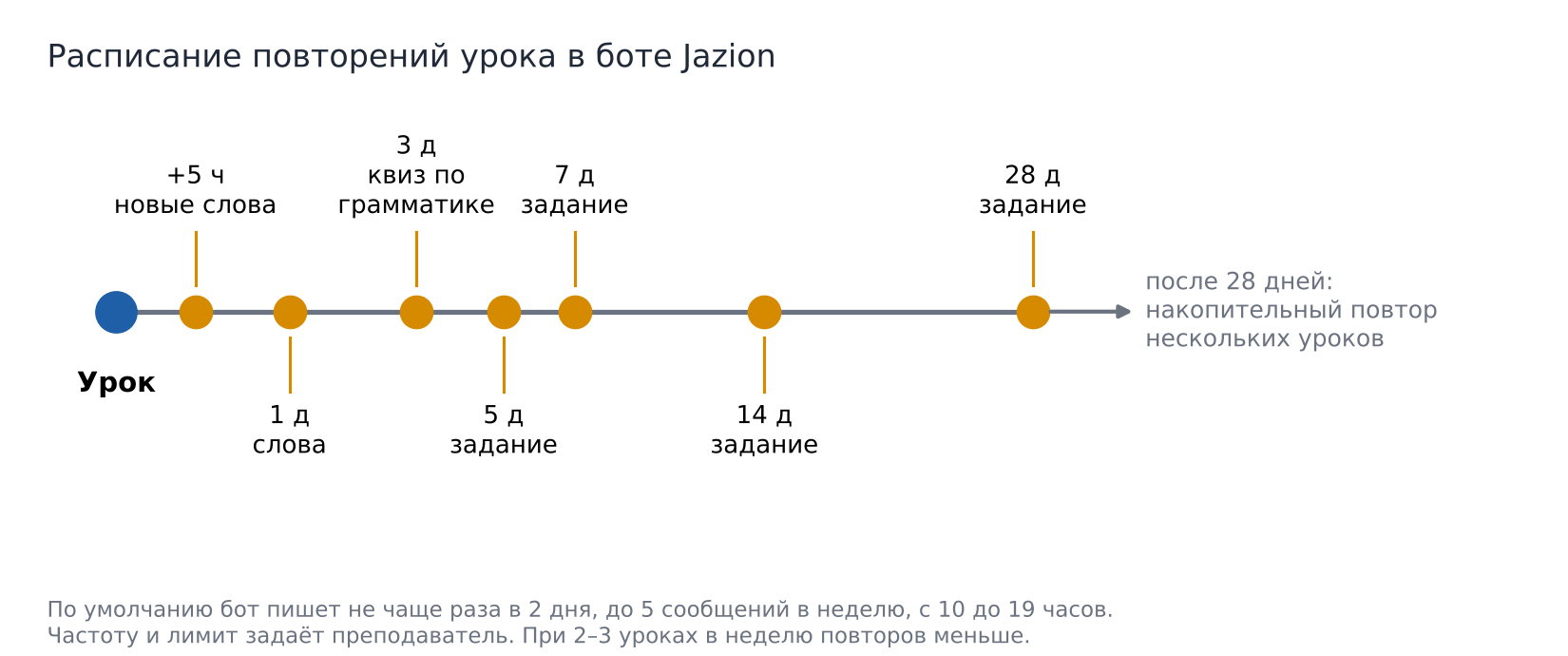 Рис. 2. Как бот расписывает повторения одного урока. Равные и растущие промежутки работают одинаково хорошо (Kim & Webb, 2022), главное, чтобы повторения вообще были.
Неделя Маши
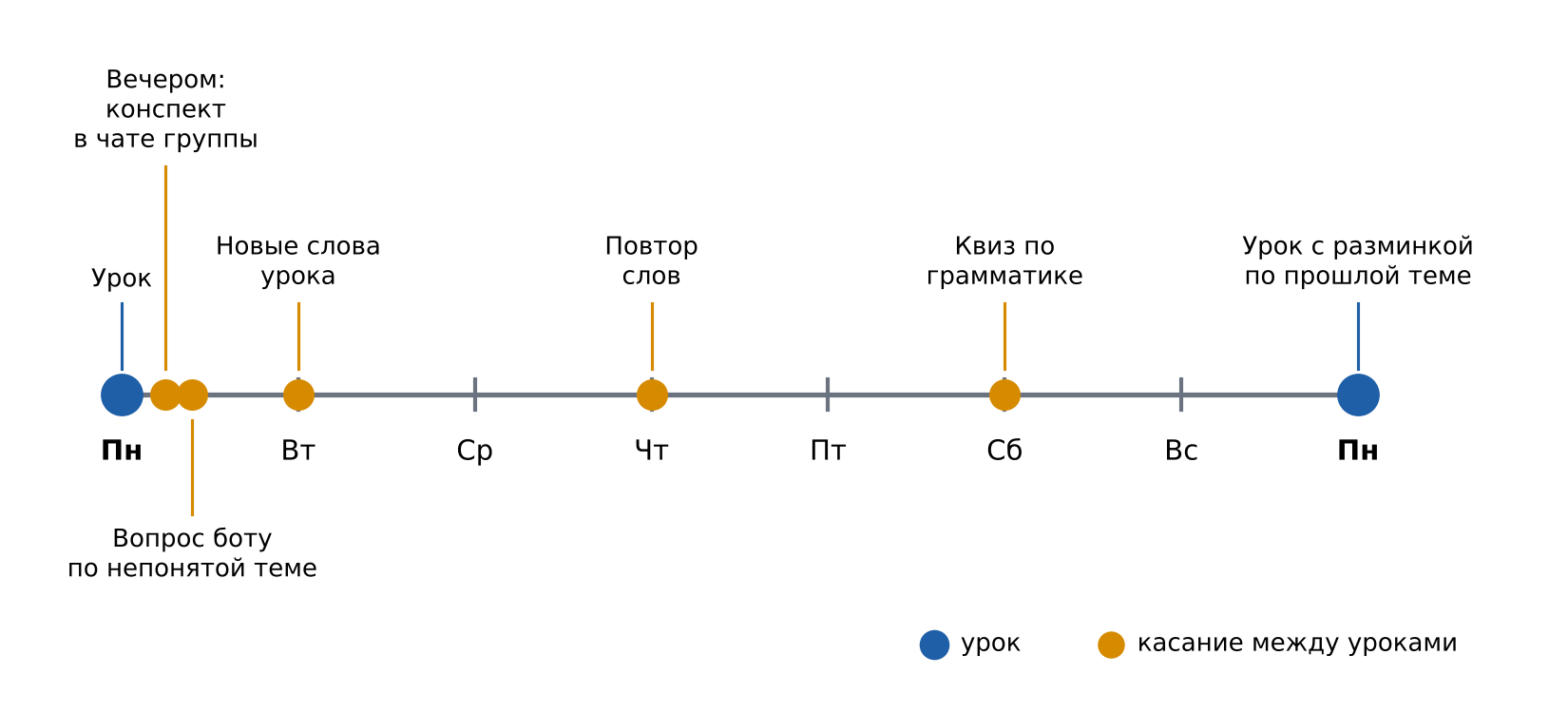 Рис. 3. Неделя Маши с настройками по умолчанию: бот пишет не чаще раза в два дня, с 10 до 19 часов.
Понедельник, 18:00. Урок английского в группе из пяти человек. Преподаватель записывает аудио на телефон и после занятия пересылает его боту. Вечером в чат группы приходит конспект.
Понедельник, вечер. Маша не поняла разницу между Present Perfect и Past Simple, но на уроке не переспросила. Вечером она спрашивает бота в чате группы: ждать следующего урока не нужно, и бот отвечает, опираясь на фрагмент урока, где преподаватель объяснял эту тему.
Вторник. Утром приходят новые слова урока: короткое задание на то, что прошли накануне.
Четверг. Повтор слов. На два вопроса Маша отвечает верно, на один ошибается.
Суббота. Квиз по грамматике урока, тот самый Present Perfect. Преподаватель включил задания в личку, поэтому Маша отвечает одна и ошибиться не страшно. Если ошибётся, сразу увидит короткое объяснение.
Следующий понедельник. Вечером преподаватель начинает урок с разминки по прошлому занятию и строит новый материал на старом.
Через две и четыре недели. Тема возвращается ещё раз, а потом попадает в накопительные повторы вместе с другими уроками.
Честно об ограничениях
- Конспект пишет языковая модель. Она может упустить нюанс или не понять шутку. Пока конспект уходит в чат без предварительной проверки преподавателем, поэтому главное стоит повторить на следующем уроке.
- Одно расписание на группу. Бот пока не подстраивает промежутки под ошибки конкретного ученика: тема, где Маша ошиблась, вернётся по общему расписанию, а не раньше.
- Интервалы дают ориентир. Данные Сепеды получены на взрослых, которые учили факты. Для грамматики и разговорных навыков лучшие промежутки могут быть другими.
- Мини-группы почти не изучены. Данные о молчании и тревоге собраны на студентах вузов. Перенос на группу из пяти человек остаётся нашим предположением.
- Бот не объясняет за преподавателя. Если тема понята неправильно, повторение закрепит ошибку.
Коротко
- Сильнее всего материал забывается в первые сутки. Если между уроками его никто не трогает, к следующему занятию остаётся немного.
- В группе к этому добавляются молчание, страх оценки и надежда, что ответит кто-то другой. Эти эффекты предсказуемы, и их можно учесть в устройстве урока.
- Лучше всего работают практика вспоминания вместо перечитывания и повторение с промежутками. Обе можно встроить в урок уже на этой неделе.
- Программа полезна там, где нужно вести график повторений для каждого ученика, и хорошо работает, когда ей управляет преподаватель.
Частые вопросы
Как часто повторять материал с группой? Отсчитайте назад от момента, когда материал понадобится: если контрольная через неделю, повторите через полтора-три дня, если через месяц, примерно через неделю (Cepeda et al., 2008). Группе, которая занимается раз в неделю, хватит трёх касаний: самопроверка на следующий день, разминка на следующем уроке и короткий повтор через три-четыре недели.
Почему ученики в группе не задают вопросов? Главная причина — страх негативной оценки: в больших потоках больше половины студентов за семестр ни разу не задали вопроса (Nadile et al., 2021). Билет на выход, анонимные вопросы и «подумай, обсуди с соседом, скажи всем» эту оценку убирают.
Что лучше: перечитывать конспект или проверять себя? Проверять себя. Через неделю у тех, кто вспоминал текст, осталось 61%, у тех, кто перечитывал, 40% (Roediger & Karpicke, 2006).
Может ли ИИ заменить преподавателя между уроками? Данные говорят, что нет. С учителем эффект ИИ был большим, без учителя около нуля (Gu & Yan, 2025). ИИ полезен, чтобы вести расписание повторений, а диагностика и объяснение остаются за преподавателем.
Хотите, чтобы урок продолжался и между занятиями? Подключите группу к Jazion: конспект и первые задания придут после ближайшего урока, а что и как часто повторять, решаете вы.
Редактор — Сергей Архипов
Источники
- Ebbinghaus, H. (1885). Über das Gedächtnis: Untersuchungen zur experimentellen Psychologie. Leipzig: Duncker & Humblot.
- Murre, J. M. J., & Dros, J. (2015). Replication and analysis of Ebbinghaus' forgetting curve. PLOS ONE, 10(7), e0120644. https://doi.org/10.1371/journal.pone.0120644
- Nadile, E. M., Alfonso, E., Barreiros, B. M., Bevan-Thomas, W. D., Brownell, S. E., Chin, M. R., et al. (2021). Call on me! Undergraduates' perceptions of voluntarily asking and answering questions in front of large-enrollment science classes. PLOS ONE, 16(1), e0243731. https://doi.org/10.1371/journal.pone.0243731
- Cottrell, N. B. (1968). Performance in the presence of other human beings: Mere presence, audience, and affiliation effects. In E. C. Simmel, R. A. Hoppe, & G. A. Milton (Eds.), Social facilitation and imitative behavior (pp. 91–110). Boston: Allyn & Bacon.
- Horwitz, E. K., Horwitz, M. B., & Cope, J. (1986). Foreign language classroom anxiety. The Modern Language Journal, 70(2), 125–132. https://doi.org/10.1111/j.1540-4781.1986.tb05256.x
- Latané, B., Williams, K., & Harkins, S. (1979). Many hands make light the work: The causes and consequences of social loafing. Journal of Personality and Social Psychology, 37(6), 822–832. https://doi.org/10.1037/0022-3514.37.6.822
- Weldon, M. S., & Bellinger, K. D. (1997). Collective memory: Collaborative and individual processes in remembering. Journal of Experimental Psychology: Learning, Memory, and Cognition, 23(5), 1160–1175. https://doi.org/10.1037/0278-7393.23.5.1160
- Roediger, H. L., & Karpicke, J. D. (2006). Test-enhanced learning: Taking memory tests improves long-term retention. Psychological Science, 17(3), 249–255. https://doi.org/10.1111/j.1467-9280.2006.01693.x
- Karpicke, J. D., & Roediger, H. L. (2007). Repeated retrieval during learning is the key to long-term retention. Journal of Memory and Language, 57(2), 151–162. https://doi.org/10.1016/j.jml.2006.09.004
- Agarwal, P. K., Nunes, L. D., & Blunt, J. R. (2021). Retrieval practice consistently benefits student learning: A systematic review of applied research in schools and classrooms. Educational Psychology Review, 33(4), 1409–1453. https://doi.org/10.1007/s10648-021-09595-9
- Cepeda, N. J., Pashler, H., Vul, E., Wixted, J. T., & Rohrer, D. (2006). Distributed practice in verbal recall tasks: A review and quantitative synthesis. Psychological Bulletin, 132(3), 354–380. https://doi.org/10.1037/0033-2909.132.3.354
- Cepeda, N. J., Vul, E., Rohrer, D., Wixted, J. T., & Pashler, H. (2008). Spacing effects in learning: A temporal ridgeline of optimal retention. Psychological Science, 19(11), 1095–1102. https://doi.org/10.1111/j.1467-9280.2008.02209.x
- Kim, S. K., & Webb, S. (2022). The effects of spaced practice on second language learning: A meta-analysis. Language Learning, 72(1), 269–319. https://doi.org/10.1111/lang.12479
- Gu, J., & Yan, Z. (2025). Effects of GenAI interventions on student academic performance: A meta-analysis. Journal of Educational Computing Research, 63(6), 1460–1492. https://doi.org/10.1177/07356331251349620
- Bastani, H., Bastani, O., Sungu, A., Ge, H., Kabakcı, Ö., & Mariman, R. (2025). Generative AI without guardrails can harm learning: Evidence from high school mathematics. Proceedings of the National Academy of Sciences, 122(26), e2422633122. https://doi.org/10.1073/pnas.2422633122
- OECD (2026). OECD Digital Education Outlook 2026: Exploring Effective Uses of Generative AI in Education. Paris: OECD Publishing. https://doi.org/10.1787/062a7394-en
- Burns, M. (2026, January 27). What the research shows about generative AI in tutoring. Brookings Institution. https://www.brookings.edu/articles/what-the-research-shows-about-generative-ai-in-tutoring/
- Kestin, G., Miller, K., Klales, A., Milbourne, T., & Ponti, G. (2025). AI tutoring outperforms in-class active learning: An RCT introducing a novel research-based design in an authentic educational setting. Scientific Reports, 15, 17458. https://doi.org/10.1038/s41598-025-97652-6
- Wang, R. E., Ribeiro, A. T., Robinson, C. D., Loeb, S., & Demszky, D. (2024). Tutor CoPilot: A human-AI approach for scaling real-time expertise. arXiv preprint arXiv:2410.03017. https://arxiv.org/abs/2410.03017
- Dunlosky, J., Rawson, K. A., Marsh, E. J., Nathan, M. J., & Willingham, D. T. (2013). Improving students' learning with effective learning techniques. Psychological Science in the Public Interest, 14(1), 4–58. https://doi.org/10.1177/1529100612453266